
From hand-stitched leather to sensor-embedded technology — 90+ years of innovation in the world’s most iconic ball
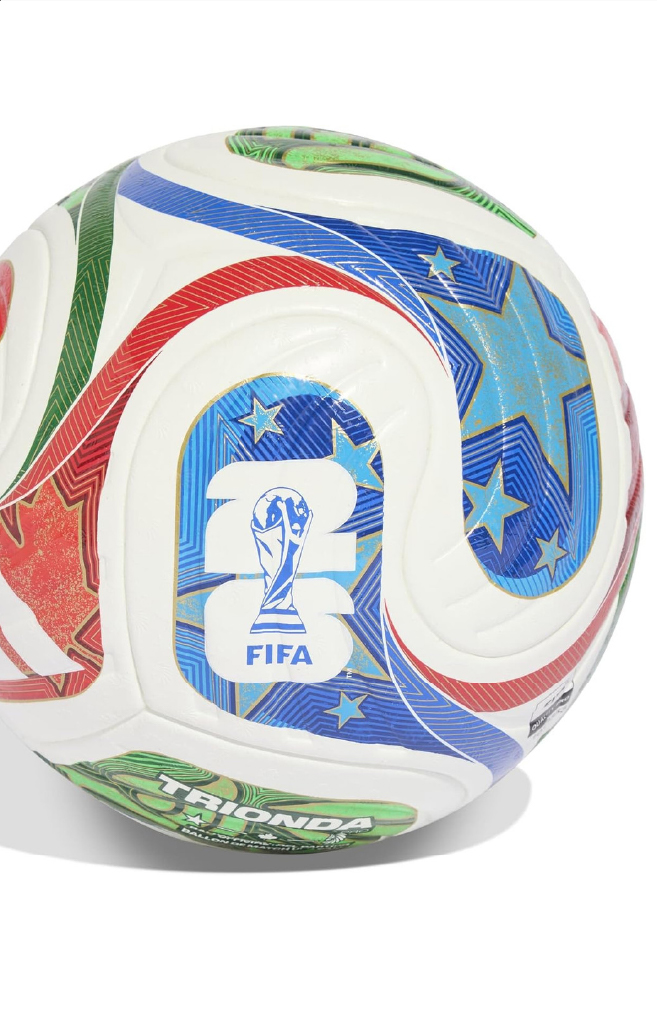
The name Trionda comes from Spanish: “Tri” (three) + “Onda” (wave/vibe), or “Three Waves.” It directly celebrates the three host nations uniting for the first time and nods to the iconic “la ola” stadium wave. The design pays homage to:
- Canada: red panels + maple leaf icon
- Mexico: green panels + golden eagle icon
- United States: blue panels + five-pointed star icon
The four panels flow together to form a central triangle in the middle of the ball, symbolizing the historic union of the three countries. Gold embellishments reference the World Cup Trophy.
New 4-Panel Construction
The fewest panels ever on a FIFA World Cup ball (previous balls had 6–32). Thermally bonded seamless surface with fluid wave geometry.
Connected Ball Technology
A 500 Hz inertial measurement unit (IMU) chip is side-mounted inside the ball. Sends real-time ball movement data to VAR + AI systems for faster, more accurate decisions.
Debossed Macro & Micro Patterns
The subtle micro patterns and strategically placed lines on the icons improve aerodynamics, swerve control, and grip (especially in wet/humid conditions).
1930 — 1966
The early balls were handcrafted leather, and the major improvements focused on basic function, consistency, and comfort. These pioneering advancements laid the groundwork for everything that followed.
1930
Two different balls were used in the first World Cup final. Uruguay chose the T-model, and Argentina prefered the Tiento. Both were standardized construction and the balls were heavy, laced, and absorbed water.
1950
Laceless Construction: First ball without laces, inflated via a valve, resulting in a rounder and more uniform striking surface.
1958
Waterproofing: Leather was treated with a waterproofing wax to help reduce moisture absorption.
1962
Latex Valve: Introduced a latex valve, helping the ball retain its shape and air pressure for longer.
1970 — 1982
With the advent of global television broadcasts, the focus shifted to visibility and resistance to the elements. Adidas became the official supplier in 1970, beginning an era of dramatic design evolution.
1970
Aesthetic & Visibility: Introduced the iconic 32-panel design (20 white hexagons and 12 black pentagons), making the ball far more visible on black-and-white television screens.
1974-1978
Protective Coating: Applied a Durlast plastic coating, making the ball water-resistant and more durable in wet conditions, preventing it from drastically increasing in weight.
1982
Waterproof Seams: Featured waterproof-sealed and rubber-infused seams for the first time, preventing water from seeping into the core. This was the last leather match ball.
1986 — 2010
The shift from leather to synthetic materials was the biggest game-changer, followed by reducing the number of panels to improve roundness and flight predictability.
1986
First Fully Synthetic Ball: Made from a synthetic/polyurethane-coated finish. Provided superior durability and significantly reduced water uptake, making it truly weatherproof.
1994
Internal Foam Layer: Covered in polystyrene foam, making the ball softer to the touch, more responsive, and faster off the foot.
1998
Syntactic Foam: Used a new syntactic foam core made of thousands of microcells to create more energy return, responsiveness, and speed.
2006
Panel Reduction & Thermal Bonding: Reduced panels from 32 to just 14, thermally bonded (not stitched) to create a smoother, more uniform striking surface for improved accuracy.
2010
Extreme Panel Reduction & Grip 'n' Groove: Reduced to only 8 spherically molded panels with textured surface for aerodynamics. Highly criticized for unpredictable knuckleball flight at altitude.
2014 — Present
The focus shifted to controlling aerodynamics and integrating live data technology to assist officiating — culminating in the 2026 Trionda’s Connected Ball Technology.
2014
Aerodynamic Redesign: 6 identical polyurethane panels with deeper, fewer seams designed to improve flight stability following the 2010 Jabulani controversy.
2018
NFC Chip: First ball with embedded NFC technology allowing fan smartphone interaction. 6-panel design with metallic print texture.
2022
Connected Ball Technology: Internal IMU sensor transmitted data 500 times per second enabling semi-automated offside. First WC ball made with water-based inks and glues.
2026
Updated Connected Ball Technology: Named from tri (three) and onda (wave) for the three host nations. Features upgraded IMU sensor system building on Al Rihla's semi-automated offside technology.